 Truefi
 Capped BRLA and Rebasing DAT
Truefi's successor ecosystem separates BRLA's capped supply from DAT's rebasing balances and dollar target. BRLA has a 1,000,000,000-token cap, while DAT adjusts supply around $1 without guaranteeing that market price. Choosing between them turns on token rights, changing balances, and the liquidity exposure that a position carries.
Key takeaway: A capped supply limits issuance, while DAT's elastic balances target a dollar price without guaranteeing the market value of a holding.
BRLA and DAT within the Brila transition
The transition from Truefi to Brila connects these tokens historically, without giving them the same function. TFIP-41, published March 5, 2026, proposed the reconstitution and the TRU-to-BRLA migration. BRLA became the successor ecosystem's governance token; DAT is a separate elastic-supply token within that ecosystem. The credit infrastructure continues under BrilaRWA. Shared branding does not make DAT a replacement name for TRU or BRLA.
BRLA's cap and circulating supply
BRLA's supply cap sets an issuance boundary; it does not determine how many tokens presently circulate. BRLA's stated maximum supply is 1,000,000,000 tokens. Allocations, unminted reserves, and release schedules sit within that ceiling. Comparing market capitalization with a fully diluted valuation requires the corresponding supply basis; using the cap as circulating supply confuses those measures.
Market demand still determines the price that buyers and sellers accept. BRLA has no dollar target that follows from its cap. Future releases from existing allocations can change the tradable supply without increasing the maximum.
DAT's elastic balances and dollar target
DAT uses an elastic supply mechanism to influence its market price, so its token balances can change. In its deployed USD peg mode, DAT targets a price of $1. Its supply can expand or contract as part of that mechanism. A rebase changes token balances without requiring a conventional purchase or sale.
DAT's non-collateralized design does not establish a dollar reserve backing every token. Its target describes a pricing objective, separate from a right to redeem against matching collateral. Sharing an ecosystem with credit or treasury products does not transfer their underlying assets to DAT holders.
DAT pricing uses an oracle-composed dollar price and DAT/WHYPE liquidity. WHYPE is wrapped HYPE. The protocol's price signal is a specific input, separate from the valuation that a wallet happens to display.
The supply response operates on token quantities, while trading determines the price at which another participant will exchange them. Adjustment rules can influence that market without ensuring that it reaches the target.
When can DAT rebasing change a balance?
DAT rebasing can run during defined execution windows, with a minimum interval between eligible adjustments. The deployed USD peg configuration uses one-hour windows and a 12-hour minimum interval. These constraints describe when an adjustment can execute; they do not promise a completed rebase every 12 hours.
The configured deadband is ±5% around the $1 target, requiring a price below $0.95 or above $1.05 for adjustment. The relevant input is the oracle-composed dollar price, rather than an isolated trade. A wallet's displayed conversion value does not independently establish that this condition holds.
Timing and price eligibility apply together. A price outside the band does not remove the execution-window constraint. An open window also does not require supply to change while the price remains inside the band.
The minimum interval limits frequency without specifying how long DAT may remain away from its target. Market-price recovery has no fixed deadline in this mechanism.
Token count and dollar value
Token count and token price jointly determine the market value of a directly held balance; a rebase changes the quantity side of that relationship. An increase in units can coincide with a lower unit price, so dollar value needs both inputs. Rebase-driven growth differs from a cash payment or a fixed yield.
BRLA's cap remains separate from the price that a sale can achieve. DAT adds balance changes to that same exposure to market pricing. For both tokens, an on-screen valuation can differ from executable proceeds when market depth is limited. Comparing their quoted prices alone also ignores their different supply structures.
BRLA order-book liquidity through HIP-2
BRLA's HyperCore order book uses HIP-2 liquidity, which operates differently from a user-managed DAT liquidity position. HIP-1 supplies the native token standard and order-book infrastructure, and BRLA has a linked ERC-20 representation on HyperEVM. Both environments belong to Hyperliquid, although wallet interactions and trading interfaces address different parts of the system.
Liquidity committed to HIP-2 cannot be withdrawn by its deployer. That lock applies to the seeded assets in the mechanism. Available trading depth still depends on the assets and orders present. Permanent seeded liquidity does not fix BRLA's market price or promise an exit for every position size. The supply cap constrains issuance; the liquidity lock constrains access to the seed assets.
DAT/WHYPE liquidity and LP staking
DAT's documented liquidity arrangement pairs DAT with WHYPE, and its LP tokens can participate in DAT reward staking. LP means liquidity provider; the token represents a position in pooled assets. Holding DAT directly and holding that liquidity position create different exposures. The latter involves both sides of the DAT/WHYPE pair, alongside the pool's rules.
LP staking rewards arrive as additional DAT, whose dollar value can change. LP staking does not establish a fixed annual return or a dollar payment. A staking distribution and a protocol supply adjustment have different causes. The underlying liquidity position also has a value separate from the reward balance.
Token rights and separate lending positions
BRLA ownership and DAT exposure create different economic positions from lending through a credit vault. BRLA functions as a governance and coordination token. Its design does not grant ownership of the Foundation, a claim on its assets, or entitlement to protocol revenues.
Credit-vault returns arise from lending arrangements and borrower interest, while a token purchase does not create that lender relationship. Elara's treasury strategies represent another distinct activity within Brila, and DAT's dollar target does not make it an Elara treasury position.
Historical TRU participation and BRLA claim support
The Brila Team's Brila Access Portal Update, dated May 11, 2026, confirmed that the broader participation window had concluded. It distinguished successful participation with technical claim problems from new participation. Support for affected claims did not establish a general reopening.
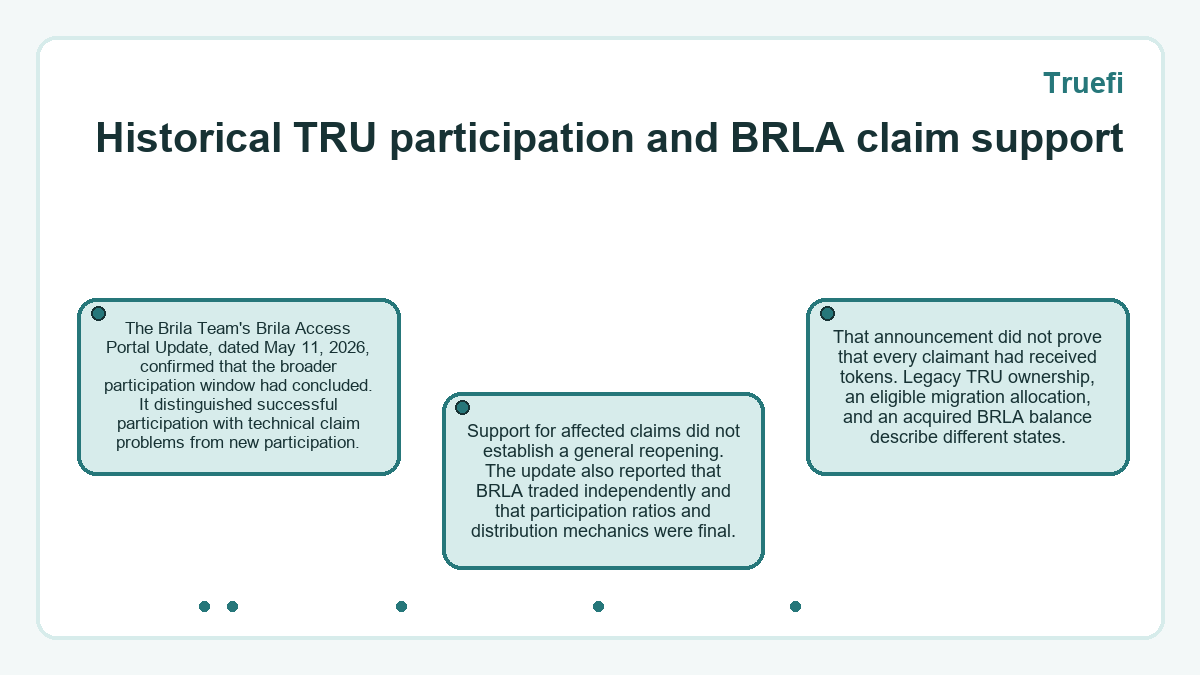
The update also reported that BRLA traded independently and that participation ratios and distribution mechanics were final. That announcement did not prove that every claimant had received tokens. Legacy TRU ownership, an eligible migration allocation, and an acquired BRLA balance describe different states.
Conditions for a BRLA or DAT position
BRLA supplies a capped token within Brila's ecosystem, while DAT supplies an elastic-balance mechanism around a dollar target.
- Use BRLA's cap to assess maximum issuance, keeping circulation and market pricing separate.
- Treat DAT as an elastic balance whose $1 target can differ from its traded price.
- Apply DAT's price condition and execution window together when interpreting a possible rebase.
- Distinguish direct DAT exposure from a DAT/WHYPE liquidity position and its DAT-denominated staking rewards.
- Evaluate executable liquidity separately from a quoted balance or a protocol's supply rule.
The next choice is the position itself: a direct token holding or the documented liquidity arrangement. A DAT/WHYPE position exposes you to both assets; earning DAT staking rewards from it requires staking its LP tokens.
Helpful answers about Truefi
Does BRLA use HYPE for HyperEVM transaction fees?
BRLA transactions on HyperEVM use HYPE for gas. BRLA's ERC-20 format describes the token interface, while the execution environment determines its gas asset. This distinction concerns HyperEVM transactions; it does not make HYPE the universal payment asset for every order, fee, or operation across the ecosystem.
Are BRLA's recorded holder and claim figures live statistics?
BRLA's recorded holder and access-allocation figures are snapshots, not live statistics. They do not establish the present holder count, circulating supply, or trading depth. A recorded percentage of access allocations claimed measures distribution progress within that snapshot; it does not measure investment performance or confirm every individual claim.
How much BRLA did the launch plan say it would mint?
Brila's April 27, 2026 launch plan specified 550,000,000 BRLA for minting at the token generation event. It also distinguished vesting arrangements and unminted supply within the 1,000,000,000-token cap. The scheduled mint amount describes that launch plan, rather than a present circulating-supply count.
Can DAT's deployed USD peg mode change its dollar target?
DAT's $1 target is immutable in its deployed USD peg mode, so that mode's target stays fixed even though its supply mechanism can change token balances and market trading can produce prices away from the target.
Why is the BRLA reserve different from contributor vesting?
The March 19, 2026 TFIP-41 clarification assigned 27% of total supply to an unminted reserve. It separately outlined multiyear vesting with a one-year cliff for team, advisor, and board allocations. An unminted reserve concerns issuance, while vesting concerns release conditions; those categories do not share a single unlock schedule.
Does HIP-2 permanently lock every order on BRLA's market?
HIP-2's permanent lock applies to assets committed to its liquidity mechanism. Independent market makers can place orders on the same BRLA order book under their own arrangements. The lock on seeded liquidity does not establish that every other order or liquidity source must remain available.