 Truefi
 credit vaults allocate loan repayments by tranche priority
Truefi credit vaults pool lending capital and allocate borrower repayments through a defined priority structure. The lending infrastructure continues under BrilaRWA, with single-tranche and multi-tranche arrangements. Senior positions receive priority over subordinated capital, while default losses can still reach every tranche. A lender holds vault shares whose value and redemption depend on the portfolio's performance and rules.
The same borrower portfolio can produce different outcomes for its lenders. Repayment priority determines their exposure, while portfolio status and controller settings determine when capital can enter or leave. Those conditions apply to the selected tranche.
Bottom line: Senior tranches remain exposed to losses that exceed the protection provided by subordinated capital.
Repayment priority and the first-loss buffer
Tranches divide a shared credit portfolio into positions with different claims on its assets. The protection for a higher-ranking position comes from subordinated capital within that portfolio. All tranches remain exposed to the same underlying loan portfolio.
The three-tranche waterfall
Priority claims
In a three-tranche credit vault, senior claims take priority over junior and equity claims. The waterfall allocates available value to senior principal and target interest first. The junior tranche follows, up to its own principal and target interest. These priorities operate within the value that the portfolio actually holds.
Residual capital
Equity receives the value left after higher-priority claims. It takes the first losses when the portfolio underperforms and receives residual upside when sufficient value remains. A fixed target rate on a senior or junior position does not remove default exposure.
Smaller tranche structures
Managers can also create single-tranche and two-tranche vaults. A single-tranche arrangement has no separate junior tranche beneath it. In a two-tranche structure, the lower-ranking position provides subordination for the higher-ranking position. The deployed structure determines which relationships actually exist.
Senior capital can still suffer losses when subordinated value cannot cover borrower shortfalls. The relevant buffer belongs to that particular tranche.
Borrower repayment and collateral exposure
The credit infrastructure supports uncollateralized institutional loans, so onchain collateral that a contract can sell is not a universal feature. For an uncollateralized loan, underwriting and borrower performance determine credit exposure. Smart contracts record obligations and payments, while a missed payment can require recovery outside the normal repayment schedule. Any collateral arrangements belong to the specific deal; the real-world asset label alone does not identify assets that a lender can immediately claim.
Capital formation before the portfolio goes live
A new structured vault begins in Capital Formation, where lenders commit capital before the manager funds loans. This stage separates fundraising from exposure to deployed credit.
Launch requirements
The portfolio must meet its configured minimum size and required tranche ratios before the manager can start it. The start changes the portfolio to Live and enables loan funding. A fundraising contribution therefore differs from capital already allocated to an active loan, even though both can appear as a lender's tranche shares.
Unlaunched capital
Capital formation has a configured deadline. If the portfolio never launches, closure enables lenders to reclaim committed capital. The documented structured contract allows anyone to close an unlaunched portfolio after that deadline, provided the portfolio is not paused. Its minimum-size and tranche-ratio conditions guard the launch; they do not insure loans once lending begins. The lender must still withdraw the available funds.
Vault shares and the underlying lending asset
Each tranche issues shares that record participation in that tranche through the ERC-4626 tokenized-vault interface. The portfolio uses one underlying asset token. Shares represent a proportion of tranche assets; the token that the borrower repays supplies the underlying value. The standard defines deposit and redemption interfaces without prescribing a credit outcome.
The interface distinguishes depositing a stated asset amount from minting a stated share amount. Withdrawal specifies underlying assets, while redemption specifies shares. Those choices determine which quantity the caller fixes and which quantity the vault calculates.
During Live operation, accrued interest, fees, and changes in portfolio value affect the assets represented by a share. A constant share balance can accompany a changing asset value. Converting shares into underlying units requires the current tranche valuation and total share supply. A wallet's share count does not identify the cash that is immediately available for redemption.
Lender eligibility and configurable controllers
Controllers are separate contracts that determine access, deposit limits, and withdrawal behavior for each tranche. Managers can configure permissioned or permissionless participation. A permissioned position may require an allowlisted address or identity verification, and requirements can differ between tranches in the same portfolio.
Know Your Customer (KYC) or Know Your Business (KYB) requirements concern eligibility where the selected product requires those checks. An approved identity does not override a disabled deposit setting or a tranche ceiling. The same separation applies to transfers: a tranche share can implement ERC-20 while its transfer controller restricts recipients. Token compatibility therefore does not establish permission to sell or move that position. One vault's access policy cannot establish another vault's policy.
Fees charged against the position
Vault costs come from the configured protocol fee, optional manager charges, and any applicable entry or redemption fee. Continuous charges depend on the asset-value fee base, elapsed time, and annualized rate. An annual fee rate is therefore not a percentage of profit alone.
The documented structured-vault implementation accrues protocol fees during Live and Closed states. Continuous management fees accrue during Live operation, while previously unpaid management fees can remain payable afterward. Contract interactions update the accounting and pay fees from available funds.
Deposit and redemption controllers can add transaction-specific charges. An entry fee can reduce the assets credited to a deposit, while an exit fee can consume assets alongside the amount withdrawn. Loan-level origination or repayment charges, where configured, belong to the instrument. Actual rates and fee logic govern these costs, independently of a promised lender return.
Recorded value and withdrawal liquidity
A reported asset value can exceed available withdrawal cash because outstanding loans contribute to portfolio accounting.
Capital that a borrower still holds remains loan exposure, even when the portfolio includes that claim in its valuation. Live withdrawals also face controller rules and required tranche ratios. Removing too much subordinated capital can conflict with the protection supporting a higher-ranking tranche. After closure, live tranche-ratio constraints no longer govern the exit, although available assets still determine the payout. A maturity date ends a contractual period; it does not cause an unpaid borrower to produce cash.
When is a credit-vault deposit complete?
A credit-vault deposit completes when a successful contract transaction records the accepted assets and issues tranche shares to the intended receiver. Before submission, check the conditions that govern that contribution:
- Match the deposit token to the tranche's underlying asset.
- Confirm that the receiving address meets the tranche's access rules.
- Keep the contribution within the current deposit limit; during Live operation, the resulting tranche values must also satisfy the required ratios.
- Read the share preview and any entry fee for the selected deposit.
A successful deposit emits a Deposit event identifying the assets credited, receiver, and issued shares. The receiver's corresponding share-balance increase confirms the recorded participation. Any configured entry fee affects how much of the contribution enters the position.
A contribution that breaches a live tranche-ratio requirement reverts and creates no additional shares. Retrying cannot override the ratio: the amount or portfolio composition must first satisfy the rule. Successful entry establishes participation; borrower repayments determine the later return.
Default recognition and recoveries after closure
Default recognition changes the value that the portfolio can allocate to lenders; it does not itself collect unpaid debt. In the documented structured implementation, the manager marks a loan as defaulted and updates tranche accounting. Subordination determines where the resulting shortfall falls.
Closing a structured portfolio does not prevent later repayments from overdue loans.
Later recoveries fill remaining priority claims recorded at closure before reaching equity. Those recoveries can change the value available to affected tranches. A closed status describes a portfolio state, while a recovered payment describes an actual inflow. The amount recovered can remain below the original obligation. Closed portfolios cannot fund fresh loans.
Legacy vaults and the BrilaRWA transition
The Brila transition carried forward the lending infrastructure while treating historical credit administration separately. An older position still has its own borrower exposure, loan status, and recovery record. The availability of a new product does not establish that an older claim has settled.
TFIP-41, published March 5, 2026, proposed keeping Archblock-related legacy recovery processes separate from the reconstituted operating platform. A restructuring announcement cannot establish the amount returned to a particular lender. BRLA governance concerns ecosystem decisions, whereas a tranche share records participation in a specific credit portfolio. Holding the governance token and holding that lending position create different exposures.
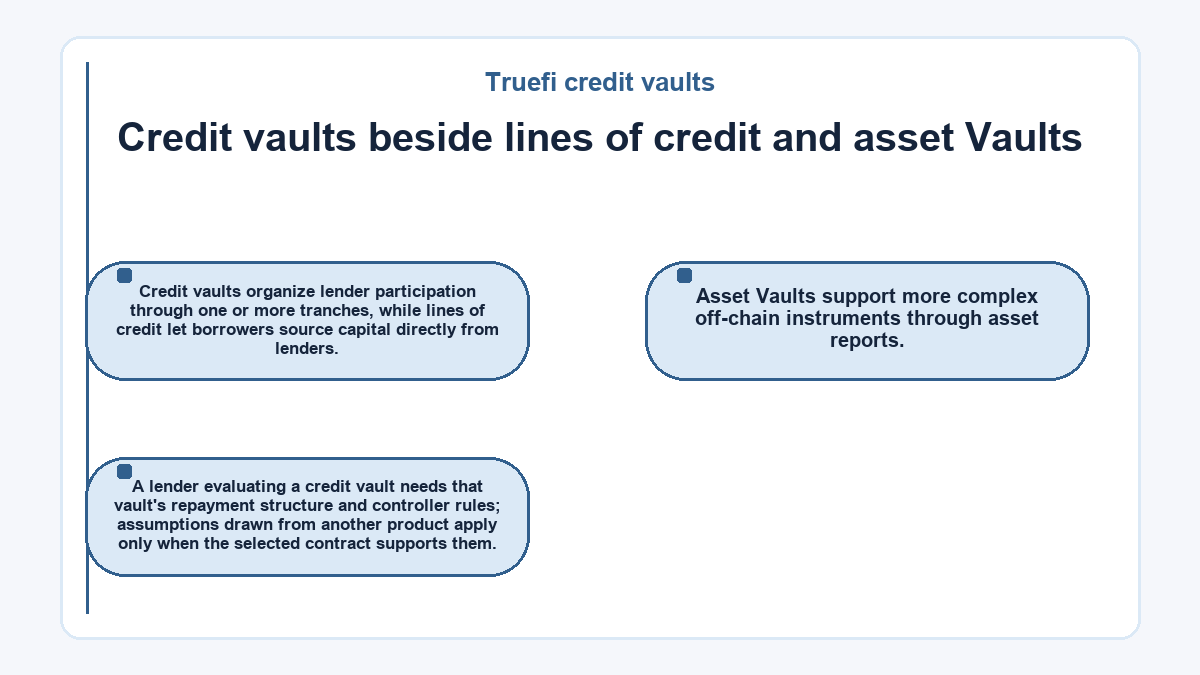
Credit vaults beside lines of credit and asset Vaults
Credit vaults organize lender participation through one or more tranches, while lines of credit let borrowers source capital directly from lenders. Asset Vaults support more complex off-chain instruments through asset reports. A lender evaluating a credit vault needs that vault's repayment structure and controller rules; assumptions drawn from another product apply only when the selected contract supports them.
Things people ask
Can a manager add another tranche to an existing credit vault?
The documented credit-vault design does not allow adding tranches to a portfolio deployed with fewer tranches. A manager who intends to use more tranches later needs to deploy them initially and restrict access to the unused ones through controllers. Opening an existing tranche later differs from creating a new tranche within an existing portfolio.
Who can create a portfolio through the vault factory?
A manager needs governance approval and an allowlisted address to deploy a portfolio through the documented factory process. Lender eligibility is a separate matter: permission to deposit into a tranche does not confer authority to create or manage portfolios. The approved manager then configures the vault within the capabilities of its deployed contracts.
Does every loan have to settle before a matured vault can close?
After the end date, the documented StructuredPortfolio contract permits closure with active loans, provided the portfolio is not paused. Before that date, closing a Live portfolio requires the manager and no active loans. Closure distributes available cash through the waterfall; it does not establish that borrowers have paid every outstanding obligation.
Are access controllers fixed for the lifetime of a credit vault?
The documented TrancheVault contract lets the tranche controller owner replace deposit, withdrawal, and transfer controllers. That authority differs from a lender's ownership of shares. Replacement controllers can change the logic governing participation, so the initial controller configuration does not establish that every access rule remains fixed throughout the position's life.
Where does a structured vault hold cash during its different states?
Tranche contracts hold their allocated idle assets during Capital Formation and after closure. During Live operation, the central StructuredPortfolio holds the portfolio's undeployed cash, while tranche contracts record lender shares and handle interactions. A tranche's accounted asset value and the central portfolio's liquid token balance therefore describe different parts of the lending structure.